
Pyrolytic stripping ovens
How does a pyrolytic stripping oven work?
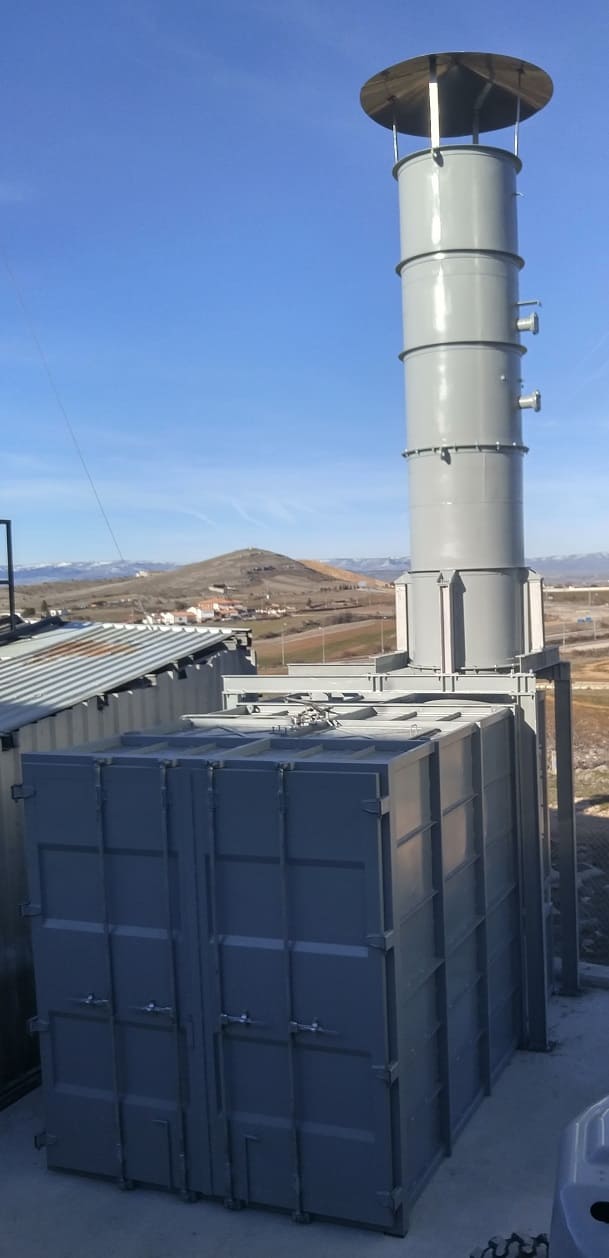
Pyrolytic stripping ovens (also called thermo-de-varnishers or, in our slang, “strippers”) are used to clean metal parts by pyrolysis. They are designed to remove residues from surface coatings (paints, varnishes, etc.) from metal supports (racks, hooks, hangers, tool holders, etc.) used to hang or house these parts during the painting or varnishing process. These supports, after several working cycles, are covered with a thick layer of the coating and are unusable
The Stripper performs this cleaning by heating the pieces to about 480ºC in an oxygen-poor atmosphere. Under these conditions, the organic matter contained in the paint or varnish breaks down into small molecules that are gaseous at that temperature. This process is called pyrolysis.
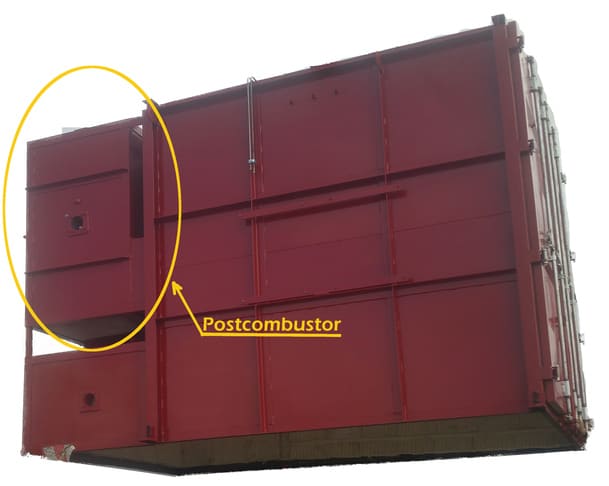
Gases generated by organic matter in the pyrolysis process are conducted through a postcombustor.
Gases generated in the pyrolysis process contain a large amount of volatile organic compounds, carbon monoxide and soot particles, since they come from an incomplete combustion of organic matter. It is unthinkable to emit these gases into the atmosphere because they would be highly polluting and the black plume would be visible for miles.
Therefore, these gases are led to an postcombustor located behind the furnace where they are subjected to a temperature of 850 ºC and with enough air so that they are completely oxidized to carbon dioxide (CO2) and water. In this way, the gases emitted into the atmosphere are completely transparent and harmless.
"Intelligent" control of the cleaning time
In the stripping process, it is very important to control the temperature inside the pyrolysis oven so that the process is carried out in a controlled manner and the pieces do not deform or deteriorate due to high temperature.
In our ovens, such temperature control is carried out by regulating the burner power but, in the event that the furnace load enters ignition, with the consequent lack of temperature control, water is sprayed inside to extinguish the ignition and regain control.
The cleaning cycle consists of:
- An initial heating ramp up to a certain temperature
- Maintaining such temperature for a time
- A second ramp to a higher temperature
- Maintaining such temperature for a time
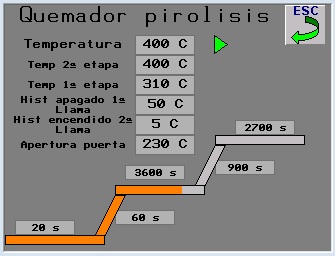
All time and temperature parameters are user-selectable on the electrical panel touch screen. Typical cleaning time is about two and a half hours.
In addition, the furnace has an intelligent detection mode for the end of the work cycle, so that it stops when it detects that the combustion of organic matter has ended. In this way, the duration time adapts exactly to the amount of organic matter introduced, saving time and energy.
The control system allows fully automatic operation and handling is as simple as selecting a recipe from the ones stored for the different types of loads (defined by the user) and pressing the start button. Thereafter, the user can be unconcerned until the oven alerts him that the cycle has ended.
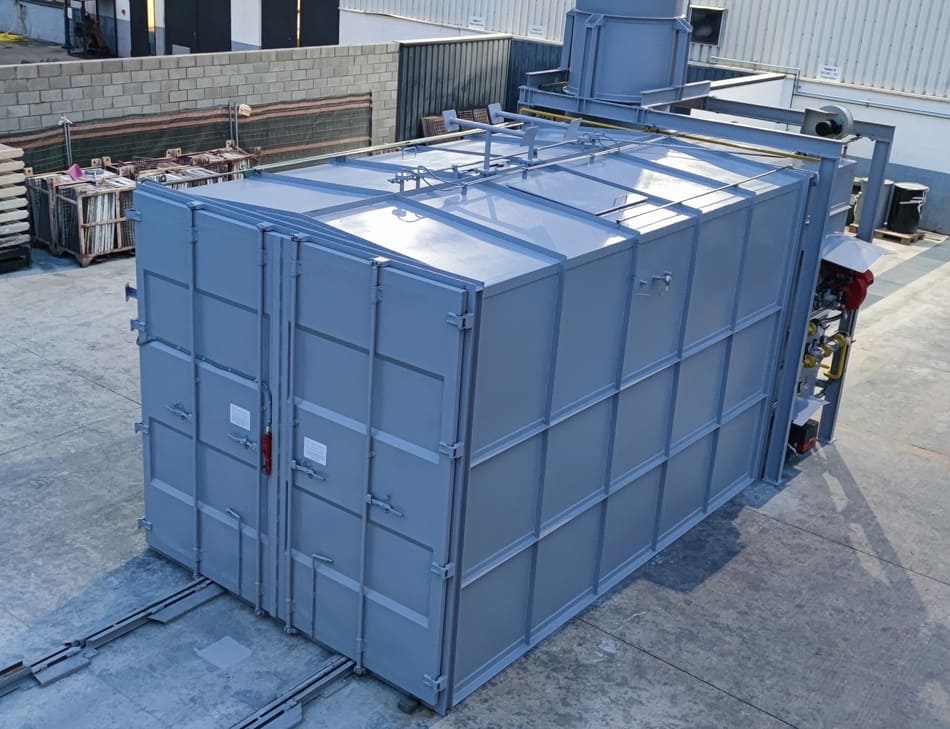
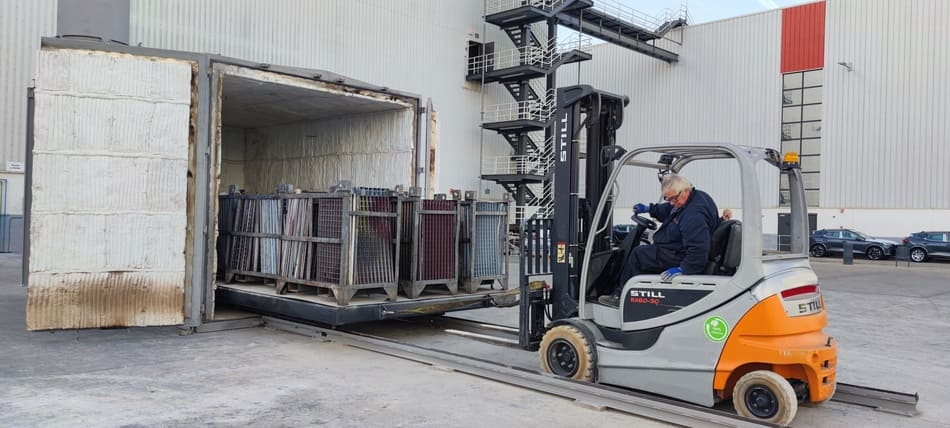
High capacity pyrolytic stripping oven. Loading with trolley on rails. The useful inner dimensions are 3 m wide x 3 m high x 5 m deep. About 10.000 kg of painted metal parts can be stripped in about 3,5 hours. The consumption of natural gas for each load is between 55 and 75 Nm³, depending on the load of paint introduced.
More information on pyrolytic stripping ovens
If you want to know in depth the operation, construction details and applications of these equipment, send us an e-mail with your contact data and we will send you a document with a detailed explanation. We will only use your data to send you this document and we will not bother you any more, unless you ask us to expand the information.
Or came and visit us
Empresarium Industrial Estate
1 Salvia street, door B35
E-50720 La Cartuja Baja (Zaragoza)
Spain