
Recuperative thermal oxidation gas cleaning
What is thermal oxidation?
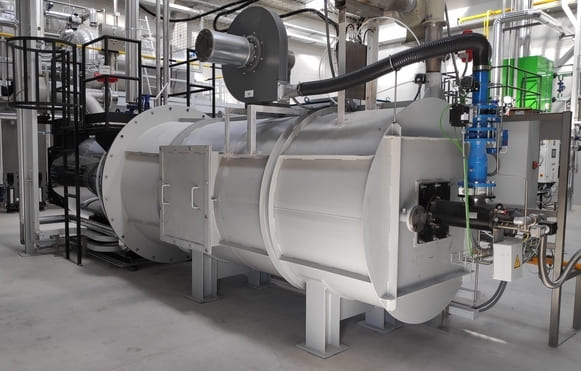
Thermal oxidation is a process that is used to remove gaseous pollutants that, when oxidized, produce others that are harmless or much less harmful. This oxidation is achieved by increasing the temperature of the gases and keeping them hot long enough for the oxidation reaction to complete. Generally, this is achieved at temperatures above 800 ° C for more than 0,8 seconds.
This technique is usually applied to the abatement of organic compounds, which are transformed into carbon dioxide (CO2) and water. But it can also be applied for the removal of inorganic compounds such as carbon monoxide (CO), hydrogen sulfide (SH2), ammonia (NH3) and some others.
If the organic compounds contain halogens, nitrogen, or sulfur, secondary compounds will form (hydrogen halides, nitrogen oxides, or sulfur dioxide) that will require post-thermal oxidation removal treatment.
Heat needs to be recovered from the exhaust gases ...
In order to reduce the external energy consumption or to recover the energy contained in the exhaust gases, the use of heat recovery devices is used.
The different ways of recovering the heat of the exhaust gases are:
- Preheating the flue gas to be treated, installing a gas / gas heat exchanger. A particular case of preheating the flue gases that achieves heat recovery efficiencies greater than 92% is regenerative thermal oxidation, explained here.
- Air heating that can be used in the industrial process, for example, to introduce it into drying ovens.
- High pressure steam generation for use as a heating medium in the industrial process.
- Generation of hot water.
- Heating of thermal fluid (thermal oil boilers) to be used as a heating medium.
These elements contribute to making the economic investment profitable and to valorizing the organic compounds present in the polluted air, since the energy released in its oxidation is used as thermal energy in the production process, reducing the overall energy consumption of the plant.
Applications
This technique is usually used when pollutant concentrations are high (greater than 8 g/Nm³). In this way, little energy is needed to achieve the purification temperature, since the heat generated in the oxidation reactions helps.
These facilities are of special interest when heat can be recovered for the production process and usually give satisfactory results in applications such as:
- Elimination of odorous compounds, including mercaptans and SH2.
- Elimination of organic aerosols that cause visible plumes in chimneys (coffee roasters, meat smoking factories, enamel baking, etc.)
- Elimination of volatile organic compounds (VOC’s) emitted by a wide variety of industrial processes (surface or part painting, printing on plastics, fabrics or paper, lamination of wood or plastic, chemical industry, etc.)
More information about recuperative thermal oxidation gas cleaning
If you want to know in depth the operation, construction details and applications of these equipment, send us an e-mail with your contact data and we will send you a document with a detailed explanation. We will only use your data to send you this document and we will not bother you any more, unless you ask us to expand the information.
Or came and visit us
Empresarium Industrial Estate
1 Salvia street, door B35
E-50720 La Cartuja Baja (Zaragoza)
Spain