
Regenerative Thermal Oxidation gas cleaning
How does a thermoreactor work?
A regenerative thermal oxidation gas cleaning system, also known as a thermoreactor or RTO (Regenerative Thermal Oxidator), is a particular case of thermal oxidation that recovers the heat from the clean gases and uses it to preheat the gases to be cleaned.
The system removes volatile organic compounds (VOC’s) and other oxidizable compounds from the gases to be cleaned, producing their thermal oxidation. This is accomplished by raising the temperature of the gases enough to combine these organic compounds with oxygen to form CO2, water, and the compounds that may result from oxidation reactions.
The temperature necessary to carry out this thermal oxidation is above 800 ºC, so it is very important to achieve the recovery of the energy contained in the clean gases to reduce the energy necessary for the treatment.
How is energy recovered from exhaust gases?
To recover this energy, the thermoreactor uses ceramic beds that act as heat accumulators, capturing the heat of the exhaust gases to transfer it, later, to the gases to be treated. The thermoreactor consists of three towers filled with ceramic elements, communicated at the top by the oxidation chamber.
The gas to be treated enters through one of the towers, whose ceramic bed has been heated in a previous cycle. The heat accumulated in the bed is transferred to the gas, which practically reach the oxidation temperature upon reaching the oxidation chamber.
A burner is installed in the oxidation chamber, which will be in charge, when necessary, of supplying the energy so that the gases reach the temperature necessary for the oxidation of organic compounds.
The hot gases leaving the oxidation chamber are passed through another ceramic bed. Initially, this bed will be cold and will capture the heat contained in the exhaust gases, which, in turn, will cool before leaving the bottom of the bed and being sent to the chimney. When the first bed is cold and the second hot, the direction of the gas is reversed and it is passed through the hot bed, which will transfer the accumulated heat to the gas to be treated.
To avoid emissions of raw gases at each change of cycle, a third tower is installed that is in “cleaning mode” while the other two towers work. Thus, when a tower has received the raw gas, it is purged by aspirating a small volume of clean gases.

Components of the thermoreactor
A) Fan: It drives the process gases through the equipment. It can be placed before or after the RTO.
B) Valves: A good seal is essential.
C) Thermal recovery towers: The heat transfer between the gases and the ceramic material that serves as a heat accumulator takes place in them.
D) Burner: Heats the equipment at startup and guarantees an adequate temperature in the oxidation chamber.
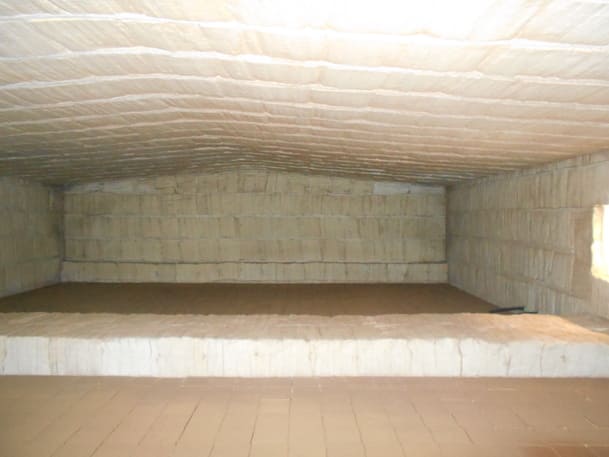
E) Oxidation chamber: Inside, gases are subjected to a temperature enough high to achieve complete oxidation of organic compounds.
More information on regenerative thermal oxidation
If you want to know in depth the operation, construction details and applications of these equipment, send us an e-mail with your contact data and we will send you a document with a detailed explanation. We will only use your data to send you this document and we will not bother you any more, unless you ask us to expand the information.
Or came and visit us
Empresarium Industrial Estate
1 Salvia street, door B35
E-50720 La Cartuja Baja (Zaragoza)
Spain